Strategy › The doubling cube
The doubling cube: when to double and when to take
The cube is what separates a friendly game from a serious one. It is a small block of numbers that quietly decides most matches — and the players who win consistently are usually the ones who handle it best, not the ones who roll best.
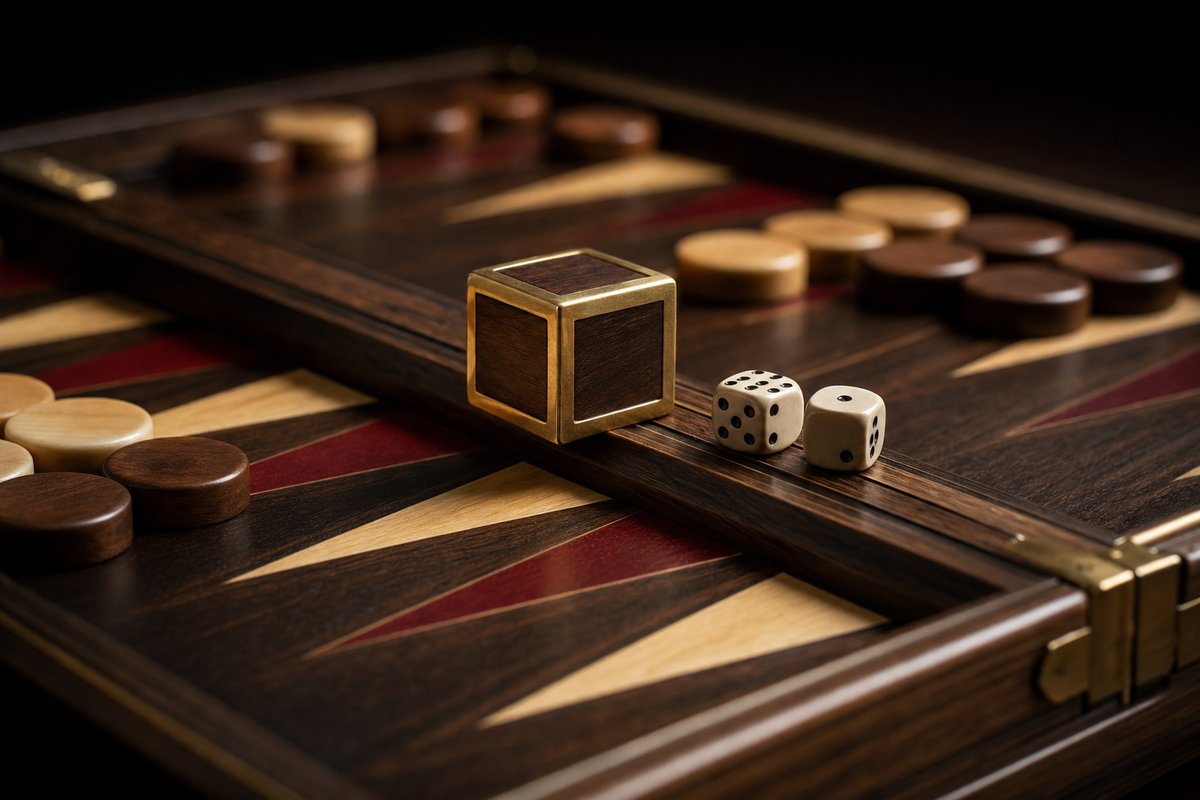
What the cube does
The doubling cube is a six-sided block showing 2, 4, 8, 16, 32 and 64. It records the stake of the current game. At the start it sits in the middle, belonging to neither player, with the game worth one point. Before rolling on your turn, you may offer to double the stake. Your opponent then makes a single decision: take the cube and play on at the higher value, or drop and hand over what the game is currently worth.
That decision repeats. Whoever takes now owns the cube and is the only one who can double next, so the stake can climb from 1 to 2 to 4 and beyond across a single game. Learning when to offer it and when to accept it is the most valuable thing you can study after the basic rules.
The take point
Start from the receiving side, because it is the cleaner number. If you are doubled, should you take? The baseline answer is the 25 per cent rule: in a simple position with no gammon chances and no future cube use, you should accept if you will win at least about a quarter of the time. The arithmetic is straightforward — passing concedes a fixed amount every time, while taking loses more when you lose but wins when you win, and the two balance out near 25 per cent.
Two things bend that figure. Owning the cube after you take has value, because you might redouble later, which pulls the practical take point a little below 25 per cent. Gammon risk pushes it the other way: if losing is likely to cost you a double game, you need more than 25 per cent to take. Treat 25 per cent as the anchor and adjust around it.
When to double
Now the giving side. You do not double the moment you edge ahead; a small lead is worth more with the cube still in the middle, where you keep the right to use it later. The time to act is when your winning chances are high and the position is volatile — when the next exchange could swing things sharply. In rough terms, the doubling window opens around 70 per cent and the opponent should still take up to about 78 per cent.
Volatility: losing your market
Winning chances tell you whether you may double; volatility tells you when. The key idea is the "market loser" — a roll after which your opponent would no longer take. If many of the next sequences would push you past the cash point, then waiting is dangerous: roll well and your opponent simply drops, and you have lost your market — the chance to double them while they still had a take. Those are the moments to double now.
When the position is calm — when almost nothing that happens next turn would change your opponent's decision — you can hold the cube safely and keep your options open, even as a clear favourite. When it is sharp, with hits, big points and swings in the air, you double before the swing, not after. This is why two positions with the same winning chances can call for opposite cube actions: the volatile one is a double, the quiet one is a wait. Learning to feel that volatility is what turns a rule-follower into a strong cube player.
Too good to double
There is a zone beyond the window where doubling actually costs you. If you are winning so heavily that you are likely to score a gammon — worth two points — then offering the cube just lets your opponent drop and limit the damage to one. When playing on for the gammon beats cashing a single point, the position is "too good" to double. You keep the cube and finish the job.
Redoubles and match play
A redouble is a double made by the player who already owns the cube. Because your opponent revealed something by taking last time, a redouble usually wants you a touch stronger than a first double would. And everything shifts again in match play, where the score changes what points are worth: near the end of a match, gammons can be worthless or decisive, and take points move with the score.
One match-play rule you will meet constantly is the Crawford rule. When one player reaches match point — one away from winning — the cube is frozen for exactly one game, the Crawford game, then comes back to life afterwards. It is named for John R. Crawford, who devised it, and it is standard in every serious match.
Putting it to work
Good cube play rests on knowing your winning chances, and the quickest route to that is a fast pip count. Count the race, estimate where you sit on the gauge above, and act. The fastest way to calibrate is to make your decision, then check it against the cube trainer — over a few hundred decisions your instinct for the take point and the window becomes reliable. Anything unfamiliar is in the glossary.
Common questions
What is the doubling cube?
A six-sided block marked 2, 4, 8, 16, 32 and 64 that records the current stake. Before rolling, the player who feels ahead can offer to double the value of the game; the opponent takes and plays on for the higher stake or drops and concedes the current value.
What is the take point?
The minimum winning chance at which it is correct to accept a double. The textbook figure is about 25 per cent for a simple position with no gammons and no recube value. Below that you should pass; above it you should take.
Why can the take point be below 25%?
Because the side that takes also gains ownership of the cube and the right to redouble later. That option has value, so in live play the practical take point dips a little below 25 per cent, often cited around 22, before gammon risk pushes it back the other way.
When should I double?
Roughly when your winning chances climb into the high-60s to high-70s per cent and you still have gammon and volatility to gain. The doubling window — where doubling is right and the opponent should still take — sits around 70 to 78 per cent.
What does 'too good to double' mean?
When you are winning so heavily that playing on for a gammon, worth two points, is better than cashing a single point by doubling the opponent out. In that case you keep the cube and play for the larger win.
What is a redouble?
A double made by the player who already owns the cube, raising it again. Because your opponent has already shown weakness by taking once, a redouble usually needs you to be a little stronger than an initial double would.
What is the Crawford rule?
In match play, once a player is one point from winning, the cube is switched off for exactly one game — the Crawford game. After that game the cube is live again. It is named after its inventor, John R. Crawford, and is standard in all serious matches.
Does the cube matter in a money game and a match equally?
The principles are the same but the maths differs. In a match, the score changes the value of points — gammons matter less when you are close to winning, and take points shift — so cube decisions near the end of a match are not the same as in a straight money game.
What happens if I double and my opponent drops every time?
Then you were doubling too late or too hard. If the opponent always passes, you are only ever winning one point when you might have built positions worth a gammon, or doubling so early that you give up the cube's value. Good doubling lives near the take/pass boundary.
Can I double whenever I want?
Only on your turn, before you roll, and only if you own the cube or it is still in the middle. Once you double and the opponent takes, they own it and you cannot double again until they have.
How much is the cube worth in practice?
A great deal. Strong players agree that cube decisions swing more points over a match than checker play does, because a single wrong pass or wrong take can cost a whole game's value at once.
How do I get better at cube decisions?
Learn to count the race quickly, so you know your rough winning chances, then study reference positions and check your decisions against the take-point figures afterwards. Counting and cube skill grow together.