Strategy › How to play
How to play backgammon
Backgammon is a two-player race around a board of 24 points, settled by the dice and shaped by judgement. The rules take ten minutes to learn and a lifetime to wear out. Here is everything you need to sit down and play your first game properly.
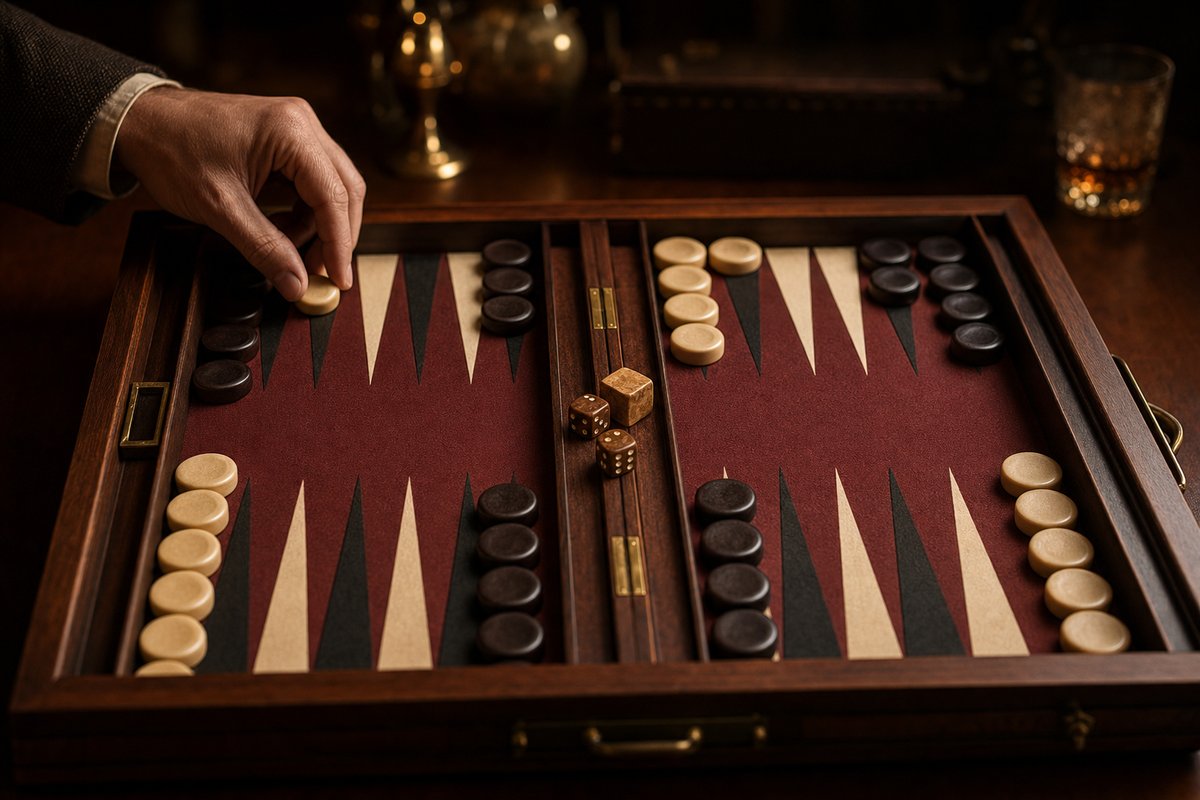
Two players, fifteen checkers each, two dice and a board. One side moves their checkers one way, the other moves the opposite way, and the first to bring all fifteen home and lift them off the board wins. That is the whole game in a sentence. The depth comes from what happens in between — when to race, when to hit, when to build a wall, and when to risk a checker on its own.
The board
A backgammon board has 24 narrow triangles called points, in four groups of six. The points are numbered from each player's own perspective: your home board holds points 1 to 6, the outer board holds 7 to 12, and the far side runs 13 to 24. The tall divider down the middle is the bar.
Two of those points have names worth knowing from the start. The 7-point is the bar point, and the 13-point is the midpoint — the spot where each player stacks their largest group of checkers. That midpoint will come up again when you learn to count the race.
Each player moves in a single direction, from the 24-point round towards the 1-point, and the two players travel in opposite directions. You are always heading home; your opponent is heading the other way, towards theirs.
The starting position
Every game opens from the same fixed layout. For each player: five checkers on the 13-point, five on the 6-point, three on the 8-point and two on the 24-point. That adds up to fifteen, and it leaves both players with an identical pip count of 167 — the total distance, in points, that all your checkers still have to travel.
The object of the game
You win by being first to bear off — to remove all fifteen of your checkers from the board. Before you can lift a single one, every checker you own must be sitting in your home board, the six points closest to you. Getting them there is the race; stopping your opponent from getting there is the fight.
Rolling and moving
Players take turns rolling two dice. The two numbers are separate moves: a roll of 6-3 lets you move one checker six points and another three, or move a single checker three and then six, so long as each leg lands on a point you are allowed to use. You may land on any point that is empty, holds your own checkers, or holds exactly one of your opponent's.
Doubles are the exception, and they are the engine of a fast game. Roll the same number on both dice and you play it four times. A 4-4 is four moves of four pips. You are obliged to use as much of your roll as the rules permit: if you can play both numbers, you must; if only one can be legally played, you play it, taking the higher number when you have a choice.
Hitting and the bar
A point with a single checker on it is a blot, and a blot is vulnerable. If your opponent's move lands exactly on your blot, your checker is hit. It comes off the point and goes onto the bar, and it has to start its journey all over again from the far side.
This is where backgammon stops being a simple race. A checker on the bar must re-enter before its owner can do anything else. To re-enter, you roll and bring it in on the matching point in your opponent's home board — a 5 enters on their 5-point. If the numbers you roll both land on points your opponent has blocked with two or more checkers, you stay on the bar and the turn is lost. Trapping an opponent on the bar behind a wall of points is one of the most powerful things you can do.
Making points and building a prime
Land two or more checkers on the same point and you own it: the opponent cannot land there, and your own blots are safe there. String several owned points together in a row and you build a prime. The strongest version is the six-prime — six consecutive points — which no checker can jump, because no single die rolls higher than six. A checker stuck behind a full six-prime is going nowhere until the wall breaks.
Most games are a tug-of-war between racing and blocking. When you are ahead, you usually want to run; when you are behind, you look to hit, hold an anchor in the opponent's home board, and build points that slow them down.
Bearing off
Once all fifteen of your checkers are home, you start lifting them off. A roll removes a checker from the point matching the number, and there are rules for what to do when the dice are higher than your furthest checker. It rewards tidy, efficient distribution — wasted pips here lose races that looked won. The full method, including how to play safe when your opponent still holds an anchor, has its own guide: bearing off without wasting pips.
The doubling cube
The cube is what turns backgammon from a pleasant board game into a serious contest. It is a six-sided die marked 2, 4, 8, 16, 32 and 64, and it tracks the value of the game. At any point, before rolling, a player who believes they are ahead may offer to double the stake. The opponent accepts and plays on for the higher value, or declines and gives up the current stake. Used well, the cube wins more points than the checkers do — which is why it has a guide of its own: when to double and when to take.
Winning, gammons and backgammons
A normal win is worth whatever the cube says — one point if it was never turned. But the margin matters. If you bear off all your checkers before your opponent has borne off any, you win a gammon, worth double. If you bear off everything while they still have a checker in your home board or stranded on the bar, that is a backgammon, worth triple. Those multipliers are why a losing position is sometimes worth fighting to salvage even one checker home.
From here
That is enough to play. The fastest way to make it stick is to start a game — pass-and-play with a friend — and let the rules become muscle memory. When you are ready to go deeper, the next steps are learning to read the race with a quick pip count, getting the cube right, and trying the variants, from Nackgammon to the Bulgarian games Tapa and Gul Bara. Anything you do not recognise will be waiting in the glossary.
Common questions
How many checkers does each player have in backgammon?
Fifteen. Each player starts with fifteen checkers arranged in a fixed opening position across the board's 24 points.
How many points are on a backgammon board?
Twenty-four, in four quadrants of six. They run from each player's 24-point, around the board, down to the 1-point in their home board where checkers are borne off.
Which direction do the checkers move?
Each player moves their own checkers in one direction only, from the 24-point towards their 1-point. The two players move in opposite directions, so you are always racing towards each other and then home.
What happens when you roll a double?
You play the number four times instead of twice. A roll of 5-5, for example, lets you make four moves of five pips each, using any combination of checkers that the rules allow.
Do I have to use both dice?
Yes, if a legal move exists for each. You must play as many of the two numbers as you can. If you can only play one, you must play the higher number where possible; if neither can be played, you forfeit the turn.
What is a blot?
A single checker alone on a point. A blot can be hit by an opposing checker landing on that point, which sends it to the bar to start its journey again.
What does it mean to be hit, and what is the bar?
If your opponent lands on a point holding just one of your checkers, that checker is hit and placed on the bar — the central divider. You cannot make any other move until you have re-entered it into your opponent's home board.
How do I re-enter a checker from the bar?
Roll the dice and enter on the point matching a die in the opponent's home board. A roll of 3 enters on their 3-point. If both matching points are blocked by two or more enemy checkers, you cannot enter and lose the turn.
When can I start bearing off?
Only once all fifteen of your checkers are in your home board (the 1-point to 6-point). If a checker is hit and sent back while you are bearing off, you must bring it all the way home again before you can resume.
What is the starting pip count?
167 pips per player. The pip count is the total number of points all your checkers must still travel to come home and bear off; both players begin level on 167.
What is the doubling cube for?
It tracks the stake. A player who feels ahead can offer to double the value of the game; the opponent either accepts and plays on at the higher stake or declines and concedes the current value.
What is a gammon and a backgammon?
A gammon is a win worth double, scored when the loser has not borne off a single checker. A backgammon is worth triple, scored when the loser still has a checker in the winner's home board or on the bar.
Is backgammon a game of luck or skill?
Both. The dice introduce luck on every roll, but over a match the stronger player wins far more often because skill governs how those rolls are used — which is why the same names appear at the top of tournaments year after year.
How long does a game of backgammon take?
A single game usually runs five to fifteen minutes. Serious play is organised as a match to a set number of points, so several games are strung together and the doubling cube decides how quickly the score climbs.
Do I need to memorise the starting position?
It helps, but you will learn it within a few games. Each player has five checkers on the 13-point, five on the 6-point, three on the 8-point and two on the 24-point — a pattern that quickly becomes second nature.