Home › Boards
Backgammon boards: how to choose one
A good board makes the game a pleasure to play and lasts for decades; a poor one frustrates and wears out. The encouraging part is that the board which plays best is rarely the most expensive. This guide explains what actually matters — in the points, the checkers and the dice — so you can spend on the things that count and skip the rest.
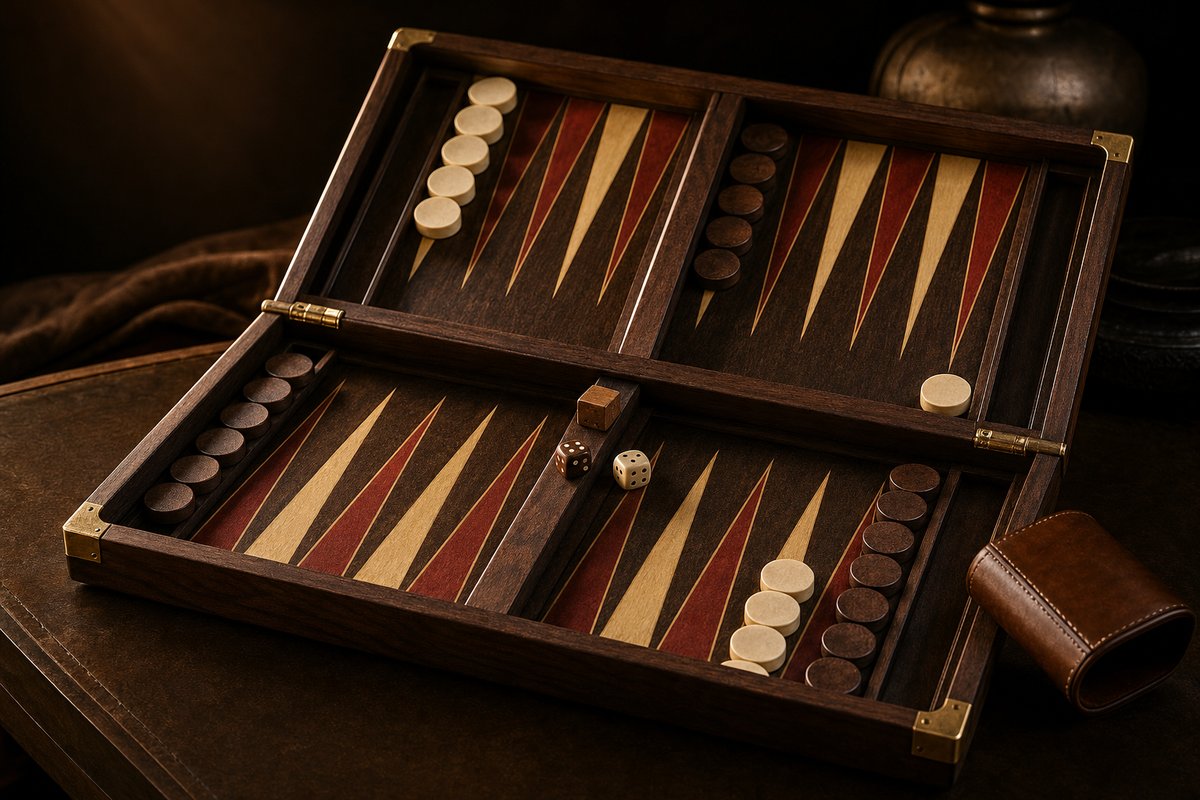
You do not need an expensive board to play backgammon well. The game has been played for five thousand years on surfaces far rougher than anything you can buy today, and a beginner learns just as quickly on a folding cardboard set as on a hand-inlaid walnut one. What a better board buys you is durability, a satisfying feel, and a board you will still want to bring out in twenty years. Knowing which features deliver that — and which are just price — is the whole skill of choosing one.
What actually matters in a board
Strip away the marketing and a backgammon set is a handful of parts, each of which can be done well or cheaply. The diagram below labels the ones worth scrutinising before you buy.
The single most telling feature is the points — the long triangles. On a cheap board they are printed onto the surface and will scuff and fade. On a good board they are inlaid: cut from separate wood or composite and set flush, so the colour runs all the way through and the board still looks well after years of use. If you check one thing, check this.
The playing surface itself may be flocked, felted or fine sanded wood. All three play fine; what you are testing is whether the surface is smooth and even, with no ridges where a checker can catch. The bar down the centre should be solid and the two halves should close cleanly if it is a folding case, with hinges that feel reassuring rather than loose.
Board sizes
Size is the first practical decision, because it dictates how the board feels in play and where you can use it. The three broad categories overlap, but they sort out neatly by use.
| Type | Rough size | Checkers | Best for |
|---|---|---|---|
| Travel / magnetic | ~11–15 in | Small, often magnetic | Trains, planes, holidays |
| Standard | ~18–19 in | Full size (~1.5 in) | Home and general play |
| Tournament | ~21–24 in | Large, weighted | Clubs, matches, display |
For most people a standard board of around 18 inches is the right answer: large enough for proper checkers and an easy reach across the bar, small enough to live on a shelf. A travel set earns its place if you actually carry it about, but the small checkers and dice are fiddlier. A tournament board is a luxury for the home player — wonderful to play on, but heavier and dearer than the game requires.
Materials and how they wear
The case material sets the price more than anything else, and each option ages differently.
- Vinyl and printed boards — the cheapest, usually a folding board or a soft case. Perfectly playable and ideal for learning, but the surface and edges wear with heavy use.
- Leather and faux-leather attaché cases — the classic carry-anywhere set, with the board on the inside lid. Durable and handsome; the hinges, zips and clasps are the parts that fail first, so test them.
- Folding wooden boards — a solid-wood board that closes like a book around the checkers. The best balance of looks, durability and portability for most buyers.
- Solid hardwood — walnut, oak, maple and the like, often with inlaid points and a fitted surface. These are the boards that last a lifetime and become heirlooms, at a price to match.
What you get at each price
Prices vary by maker and country, so treat these as broad bands rather than exact figures. They describe what your money tends to buy, not a recommendation of any particular set.
| Tier | Typical range | What you get |
|---|---|---|
| Entry | ~£20–50 | Folding or vinyl board, printed points, light checkers. Fine for learning. |
| Mid | ~£60–200 | Solid wood, inlaid points, weighted checkers, cups and a cube. The sensible buy. |
| Premium / heirloom | £300 upwards | Fine hardwood or leather, hand-finished, often from a specialist maker. Bought for the pleasure of owning it. |
The honest summary is that the mid tier is where the value lives. A solid wooden board with inlaid points and weighted checkers will play as well as a board costing ten times as much, and will outlast you. Spend above it for the materials and the craftsmanship, not for any edge at the table.
Checkers, dice and cups
These are easy to overlook and quick to spoil a set. Checkers should sit flat on a point with a little room around them, and a stack should not overhang the edges; weighted checkers feel better and stay put when the board is nudged. If a board is sold without checkers, measure the points before buying replacements so they fit.
Dice matter more than they look. Ordinary dice are fine for casual games, but a subtly unbalanced die skews results over hundreds of rolls, which is why club players favour precision dice — machined to exact dimensions with the pips drilled and filled flush. Dice cups should have an interior lip, or trip, that tumbles the dice on the way out so they cannot be slid out in a controlled way. Two cups, two dice each, and a doubling cube make a complete adult set.
Which board for which player
Looking after a wooden board
A good wooden board asks very little. Keep it out of direct sunlight and away from radiators, because heat and strong light fade the wood and can warp a folding case over time. Clean it with a dry or barely damp cloth rather than household sprays, and give a solid-wood board an occasional light wipe of furniture or wood oil to keep the grain from drying out. Store it closed and flat, with the checkers inside, and it will look as good in twenty years as it does today.
Try before you buy
The best way to learn what you like is to handle a few boards in person, and a backgammon club is the easiest place to do it. Members bring everything from pocket travel sets to fine wooden boards, and most are glad to let you feel the difference between a printed surface and an inlaid one before you spend a penny. If you are still learning the game itself, start with the rules and a few games in your browser — you will know far better what you want from a board once you have played on a screen for a week.
Common questions
What size backgammon board should I buy?
For home play a standard board of roughly 18 to 19 inches is the comfortable default — big enough for full-size checkers and an easy reach across the bar. A travel set of around 11 to 15 inches packs away neatly but uses smaller checkers and dice. Tournament boards run larger again, around 21 to 24 inches, with generous points and deep wells.
Are expensive backgammon boards worth it?
Only past a point. A solid mid-range wooden board with inlaid points and weighted checkers plays as well as anything and lasts for decades. Premium and heirloom boards buy you finer materials, hand-finishing and looks — a genuine pleasure to own, but no advantage in play. A beginner loses nothing by starting with an inexpensive set.
What is the difference between inlaid and printed points?
Printed points are screened onto the surface and can wear or scuff over time. Inlaid points are cut from separate pieces of wood or material and set flush into the surface, so the colour goes right through and the board ages well. Inlay is the mark of a better board and is worth looking for above most other features.
How big should the checkers be?
The checkers should sit flat on a point with a little room to spare, and a stack of them should not overhang the point's edges. Most standard boards take checkers of about 1.4 to 1.5 inches across. If a board is sold without checkers, check the point width before buying replacements so they fit.
What are precision dice and do I need them?
Precision dice are machined to exact dimensions with the pips drilled and filled flush, so the weight is even and the rolls are as fair as dice can be. Casual players are fine with ordinary dice; club and tournament players often prefer precision dice because a subtly unbalanced die skews results over many rolls.
Why do dice cups have a lip inside?
The interior ridge, sometimes called a trip or a lip, tumbles the dice as they leave the cup so they cannot be slid out in a controlled way. It is a fairness feature, and most serious play requires both players to roll from a cup with a trip rather than by hand.
Wood, leather or vinyl — which lasts longest?
Solid hardwood lasts the longest and ages best if it is looked after. Good leather and faux-leather attaché cases are durable and travel well, though hinges and zips are the usual weak points. Inexpensive vinyl and printed cardboard boards are fine for learning but wear faster with heavy use.
Do I need a board with a doubling cube?
If you intend to play with the doubling cube — and most adult play does — then yes, look for a set that includes one, or buy a cube separately. Many travel and budget sets leave it out. The cube is inexpensive on its own, so a missing one is not a reason to reject an otherwise good board.
How should I look after a wooden backgammon board?
Keep it out of direct sunlight and away from radiators, since heat and strong light fade the wood and can warp a case. Wipe it with a dry or barely damp cloth rather than household cleaners, and a wooden board benefits from an occasional light coat of furniture or wood oil. Store it closed and flat.
Can I try boards before buying one?
Yes — a backgammon club is the easiest place to handle different boards and ask owners what they rate. Members usually bring a range of sets, from travel boards to fine wooden ones, and are happy to let you feel the difference before you spend. The club directory lists groups across the UK.
What is a good first backgammon board?
A mid-priced wooden board of about 18 inches with inlaid points, weighted checkers, two dice cups with a trip, a pair of dice and a doubling cube covers everything a new player needs and will not need replacing as you improve. A folding case version is handy if you want to carry it to a club.