Strategy › Priming & blitzing
Priming and blitzing
When you are ahead and your opponent has checkers stuck in your half of the board, you have two ways to press the advantage: trap them behind a wall, or attack and shut them out. These are the prime and the blitz — the game's two great offensive plans.
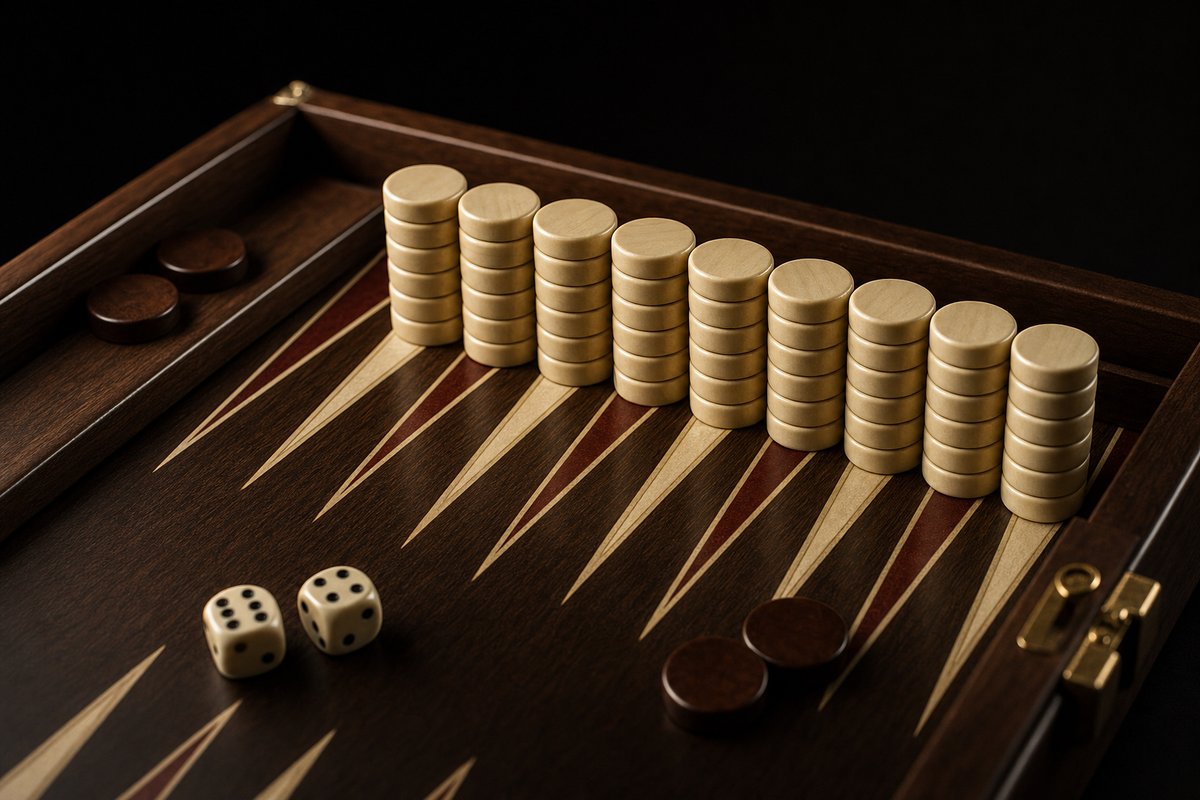
Most decisive games turn on what you do with your opponent's back checkers — the ones still deep in your home board and outfield. If you can either wall them in or knock them out, you win far more than your share. Priming walls them in; blitzing knocks them out.
Making points and building a prime
Land two or more checkers on a point and you own it — the opponent cannot land there, and your checkers are safe. String several owned points together in a row and you have a prime. The strongest version is the six-prime: six consecutive points, which no checker can jump, because no single die rolls higher than six. A checker stuck behind a full six-prime is going nowhere until the wall is forced to break.
You rarely build all six at once. The usual aim is a broken prime of four or five points that already makes escape hard, extended and tidied as the game goes on. The order of value is clear: the 5-point first, then the bar point (7), with the 6-point and 8-point — which you start with — anchoring the wall. Those four points, 5 through 8, are the heart of almost every prime.
Priming is patient. You make points, you keep your structure intact, and you let the trapped checker cost your opponent rolls. The risk is timing: if your own checkers are forced to move before the trap pays off, the prime crumbles. A prime is only as good as your ability to hold it.
The blitz
A blitz is the opposite temperament — speed, not patience. When your opponent leaves loose checkers in your home board and your board is already part-built, you attack: hit the blots, send them to the bar, and rush to make your remaining home-board points so they cannot re-enter. Close all six and they are shut out completely, unable to move at all until you open a point.
A successful blitz often wins a gammon — double the stake — because while your opponent dances on the bar, you bear in and off before they have played a checker. The danger is the half-finished blitz: if you attack, leave blots of your own, and then fail to close the board, the return hits can swing the game hard against you. Blitz when the reward is real and your board can finish the job.
Choosing between them
The position usually tells you which plan fits:
- Blitz when your opponent has loose checkers to hit, your home board already has three or four points, and you have spare checkers (builders) ready to make more. Speed and aggression are rewarded.
- Prime when you cannot attack cleanly — the opponent holds a made anchor rather than loose blots — but you can build a wall in front of it. Here patience pays: you wall the anchor in and grind it down.
Many games shift from one to the other. A blitz that does not close out can settle into a priming game; a prime that earns a shot can flare into an attack. Reading which plan the position wants — and switching when it changes — is a large part of strong play.
When the wall must break
Every prime eventually has to move. The skill is in rolling the prime forward — breaking the back point of the wall while making a new one in front, so the trapped checker still faces six closed points as the whole structure shifts toward your home. Done well, you can hold a prime for many rolls and march it home almost intact. Done badly, one awkward roll opens a gap and the prisoner escapes. When you do let a checker out, make sure the rest of your position — your race lead and home board — is ready to cash the advantage.
Common questions
What is a prime in backgammon?
A prime is a wall of consecutive made points. A full six-prime — six points in a row — cannot be jumped by any single die, so an enemy checker trapped behind it cannot escape until the wall breaks.
What is a blitz?
A blitz is an all-out attack on the opponent's back checkers: you hit their loose checkers, send them to the bar, and try to close your home board before they can re-enter, aiming for a quick win or a gammon.
Should I prime or blitz?
Roughly: blitz when your opponent has loose checkers and your home board is already strong, so you can attack and close out; prime when you cannot attack effectively but can build a wall in front of their anchor. The position usually points clearly to one or the other.
What is the most valuable point to make?
The 5-point and the bar point (7-point) are the two most valuable, because together with the 6-point and 8-point they begin the wall that blocks the opponent's back checkers. Making your 5-point early is the strongest single thing you can do.