Features › A gambling game
Backgammon has always been a gambling game
Backgammon is usually introduced as a sociable board game that happens to have a betting device bolted on. The history runs the other way round. For most of the five thousand years people have been pushing checkers around a track of points, the stakes were the point — and nearly everything the modern game is admired for grew out of them.
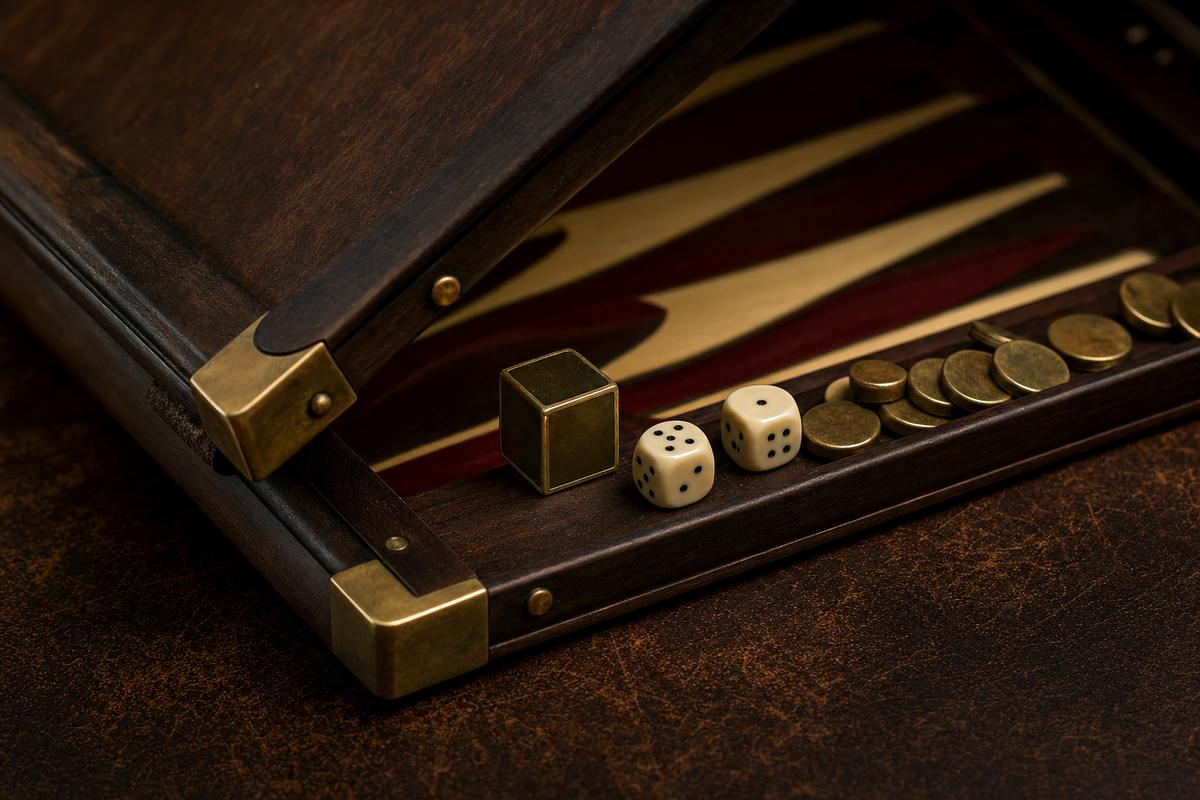
Before there was strategy, there were stakes
The oldest board game anyone can still sit down and play is the Royal Game of Ur, a race game from Mesopotamia dated to roughly 2500 BC and now held by the British Museum. It is not backgammon, but the family resemblance is obvious: two players, a track of squares, and dice that decide how far you travel. Sets have turned up in royal tombs and, more tellingly, scratched into palace steps and temple thresholds by the people who worked there. Boards carved into a doorstep are rarely the mark of a purely contemplative pastime.
By the Roman period the line to backgammon is direct. Ludus duodecim scriptorum, and later tabula, were played on boards of points with two or three dice, and Roman writers treat them as betting games without feeling any need to explain why. Suetonius, in his life of Claudius, records that the emperor was “greatly devoted to gaming, even publishing a book on the art”, and had a board fitted to his carriage so that travelling would not interrupt a game. What survives of the Roman game is not a body of opening theory. It is a body of complaint about how much money was moving.
Banned by kings, played anyway
Rome's answer was to restrict betting on dice to the December festival of Saturnalia, which tells you precisely how much betting on dice was happening the other eleven months. Medieval Europe repeated the experiment with no better result. Tables, the family of games that eventually narrowed into backgammon, was prohibited by church councils and by crowns across the continent; Louis IX of France banned it outright in 1254 and had gaming boards destroyed. The bans kept being reissued, which is the surest evidence that nobody was obeying them.
When Edmond Hoyle published A Short Treatise on the Game of Back-Gammon in 1743 — the first real rulebook, and the reason the phrase "according to Hoyle" exists at all — he was not writing for hobbyists in need of a hobby. He was writing for gentlemen who needed an agreed answer to what a disputed position was worth before the money changed hands. Codified rules were a commercial necessity long before they were a sporting one.
The cube gave the wager a shape
The most consequential thing that ever happened to backgammon was the arrival of the doubling cube, and it arrived for one reason: to get more money onto the table. Nobody is certain who thought of it. The usual account, set down by Oswald Jacoby and John Crawford in The Backgammon Book, credits an unnamed player in New York in the mid-1920s; a rival version, drawn from a 1930 magazine piece, points at the exiled Grand Duke Dmitri Pavlovich. Neither claim has ever been settled, and both agree on the setting: a private club, playing for stakes.
What the cube did was convert a wager into a decision. Before it, a game either resolved quickly or dragged on with the result already obvious. After it, every turn carried a live question — is this position worth twice what it was worth a moment ago, and will the other player agree? That single question is the whole of modern cube strategy, the deepest part of the game and the part good players spend years on. It exists because somebody wanted a way to bet more.
The Bahamas, 1964
The twentieth-century boom sat on the same foundation. Prince Alexis Obolensky organised the first international tournament in the Bahamas in 1964 and founded the World Backgammon Club three years later. What followed was a decade in which the game escaped the clubs and turned up in hotel lobbies and the design pages of magazines. The boards got more expensive and the cases got smarter, and none of that happens around a game with nothing riding on it.
The familiar 1970s picture of backgammon — Mayfair basements, Manhattan apartments, a cube sitting at 8 while somebody thinks — is not a pastime that later acquired a gambling problem. It is a stakes game in good tailoring, which is what it had been all along.
The stakes moved online
Digital boards did not change the arrangement so much as make it easier to audit. Play now happens on servers that log every roll, and the money side of it has been pulled into licensing regimes that vary sharply from one jurisdiction to the next. Canada is a useful illustration: Ontario opened a licensed online gambling market in April 2022, while most of the rest of the country still routes online play through provincial corporations, so what is permitted in Toronto and what is permitted in Halifax are genuinely different things. Anyone weighing up the best gambling sites in Canada is therefore comparing licences at least as much as products, which is why mainstream newspapers now publish their own assessments — the Toronto Star's gambling site rankings among them.
Backgammon itself sits awkwardly in all of this. It is a skill game with a wagering instrument built into its core rules, so regulators tend to file it next to poker rather than next to the machines. Most people who play it online today play for nothing at all — which would have struck any previous century as the eccentric option.
You can read the history in the vocabulary
The clearest evidence for all of this is the language club players still use. A beaver — an immediate redouble by the player who has just been doubled, keeping the cube — only exists in money play, and only when both sides have agreed to it beforehand. The Jacoby rule, which stops gammons counting double until the cube has been turned, exists solely to stop a stronger player quietly grinding out an undoubled gammon for extra cash. Neither term has any meaning in a tournament match, yet both are in the glossary, because they are still in use every week in club rooms.
Chouette works the same way. The format, in which one player takes on a team of opponents who each carry their own cube, was invented so that more people could get a bet on a single board. It survives because it is sociable, but it was designed as a money format and it still behaves like one.
Free play is the recent invention
The version most people meet first now is an app or a browser board with nothing at stake, and that is the genuinely new development in a very old game. It has been good for backgammon: more beginners, faster learning, and a route into club play that does not start with an awkward conversation about money.
It is still worth knowing where the elegance came from. The cube that gives the game its depth, the rules Hoyle wrote down, the tournaments that turned it into a sport — each arrived because people were playing for something and needed the terms agreed first. Backgammon did not have gambling attached to it. It grew out of it.
Common questions
Has backgammon always been played for money?
For most of its history, yes. Roman writers describe tabula as a betting game, medieval authorities banned tables repeatedly because of the wagering, and the first English rulebook was written so players could settle disputed positions before paying up. Playing purely for fun is the recent development.
Who invented the doubling cube?
Nobody knows for certain. The most repeated account, from Oswald Jacoby and John Crawford, credits an unnamed New York club player in the mid-1920s. A competing version names the exiled Grand Duke Dmitri Pavlovich. Both accounts place it in a private club where the game was being played for stakes.
What is the difference between money play and match play?
Money play scores each game on its own, so the cube can climb without limit and rules like the beaver and the Jacoby rule apply. Match play runs to a fixed target score, which changes cube strategy completely and makes those money-play conventions irrelevant.
Is backgammon a game of skill or a game of chance?
Both, in a proportion that shifts with length. A single game turns heavily on the dice, but over a long match or a session the stronger player wins nearly every time. That is why the game is usually classed alongside poker rather than alongside pure chance games.